
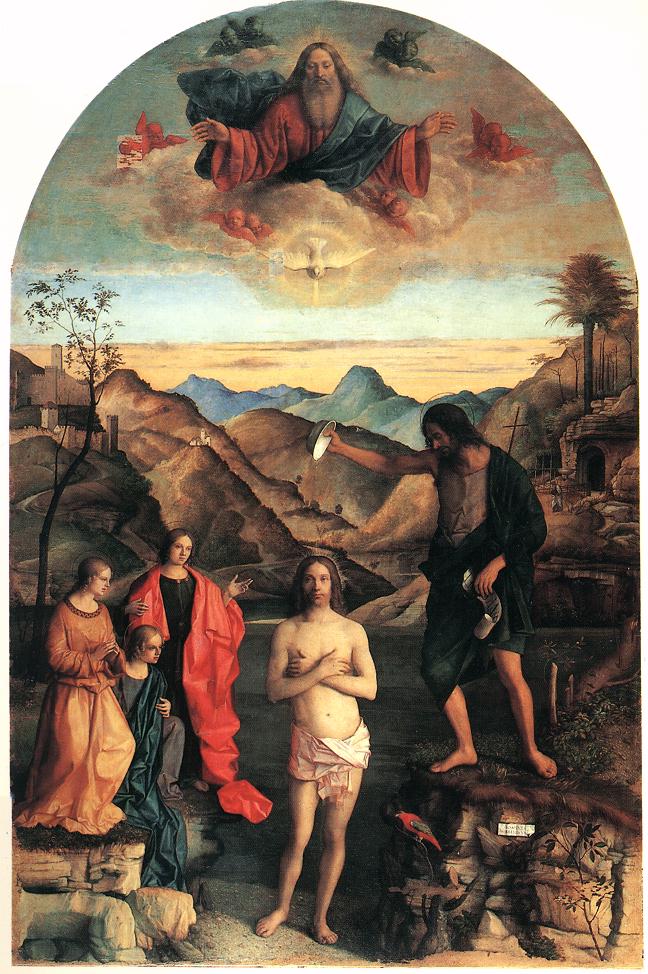
“The Baptism of Christ”, Giovanni Bellini, 1500 -02, Church of Santa Corona, Vicenza.
Christ stands stripped for baptism. A mysterious light catches his pale flesh of Christ. Set against the shaded valley of the river Jordan, his flesh seems to glow. The light catches the inside of the bowl from which John the Baptism has cured the water on his head, but John himself remains largely in the shadows. The focus is on Christ alone. Bellini adheres to a traditional composition. It is easy to see an echo of icons of the baptism and also of earlier Italian works, such as Piero della Francesca’s version now in London. As in Piero’s work there is a stillness about this composition. Bellini uses atmospheric effects to distinguish the heavenly and earthly realms.vThe mysterious light from the lower right catches the pale inside of the bowl. It draws our eyes upwards to the heavenly realm from which the Spirit descends, and where we see the Father, clothed in majestic red and blue, surrounded by cherubs. In keeping with the tradition there are three female figures to the left. The nearest one joins her hands in prayer but the other two bear the garments of which Christ has divested himself. Looking up you can see that these are the garments of divinity, as worn by the Father. It was said that the waters of the Jordan ceased to flow when Jesus was baptised and so Bellini shows him standing on the dry gravel of the riverbed. Behind him the dark waters of the Jordan are held back. We can pick out the line of the water’s surface just behind his shoulders. These waters are still, as in the legend, but there is no reflection of the sky or the heavenly scene above. The stilled waters of the river remain in shadow so that at eye level the visual focus is on Christ in the moment when the Father speaks and the Holy Spirit descends. This painting can still be found in situ in the side aisle of the Dominican Church of Santa Corona in Vicenza. In 1259 the Bishop of Vicenza had been given a precious relic of a thorn taken from the crown of thorns and had entrusted it to the Dominican friars of Vicenza. They named their convent and church after the relic – Santa Corona. From around 1480, alterations had been made to the church interior to create a shrine for the relic under the high altar. Shortly afterwards, the commission for this painting came from a man named Battista Graziani, who had made a vow to erect an altar dedicated to his patron, St John the Baptist, if he returned safely from a pilgrimage to the Holy Land. It is very likely that Bellini had pilgrims in mind who would pass the painting as they came to venerate the relic. This may explain why Christ’s hands are not joined as was usual, but are folded across his chest, which is a clear reference to Christ as the man of sorrows. Pilgrims who came to venerate the holy thorn would pause before this painting to contemplate Christ’s pure unblemished flesh, which was wounded for their sake. And perhaps if you stood in the nave, and let your eye move vertically downwards from the Father’s red garment to the Son, and then horizontally, beginning with his red garment on the left, you would trace with your eyes, and maybe your hand, the sign of the cross.
The Catholic Chaplaincy serves the students and staff of the University of Edinburgh, Edinburgh Napier University and Queen Margaret University.
The Catholic Chaplaincy is also a parish of the Archdiocese of St Andrews and Edinburgh (the Parish of St Albert the Great) and all Catholic students and staff are automatically members of this parish.


Follow us for news updates and inspiration. Website design by Colour Rich
St Albert's Catholic Chaplaincy is part of the English Province of the Order of Preachers, a charity registered in England and Wales (231192) and in Scotland (SC039062).