
https://www.nationalgallery.org.uk/paintings/NG1140
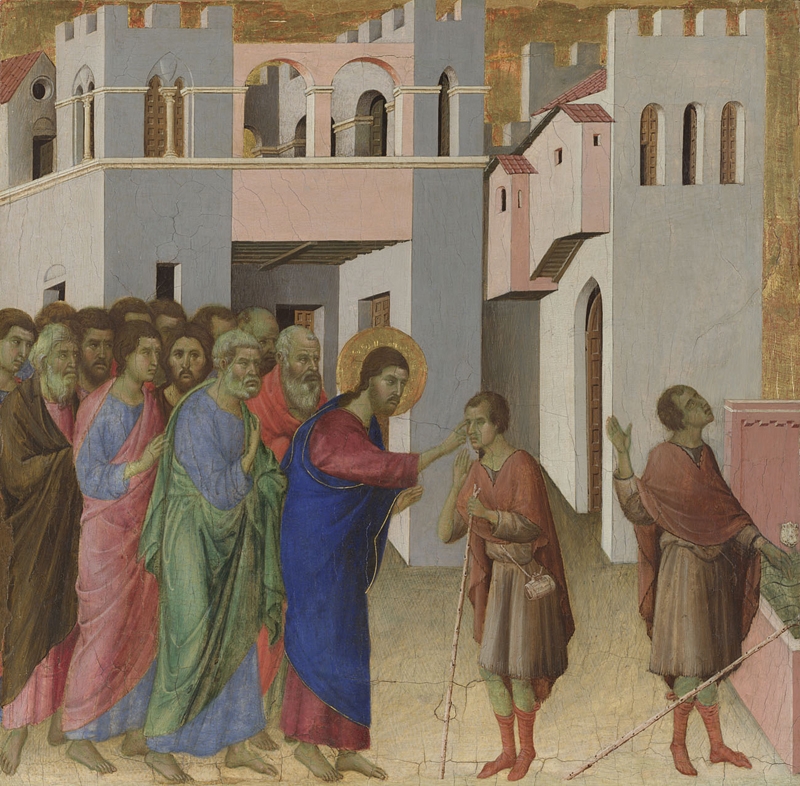
In today’s gospel we have the healing of the man born blind. The miracle was shown in this panel from Duccio’s Maestà: his great altarpiece made for the Cathedral in Siena. In the centre, before his disciples, Jesus anoints the man’s eyes with clay and saliva. On the right the man stands at Pool of Siloam where Jesus had sent him to wash and where the man gained his sight. Notice how, when blind, the man grips the stick with which he made his way along the Jerusalem streets. At the pool, the man has dropped his stick and, with one hand still in the water, he raises the other and looks upward as if giving thanks and praise for the gift of sight. One hand speaks of the waters of baptism, the other of faith. In fact, in the original arrangement of the panels of the Maestà, the man, now sighted, is looking towards another panel which shows the Transfiguration. This implies that the miracle is a sign of coming to faith in Jesus, not just as a healer, but as the Son of God. In blindness the man faces the natural light but sees nothing. At the pool he looks away from the natural light but sees supernatural light, albeit in the adjacent panel. When the disciples first saw the man born blind, Jesus said that he was there so that “the works of God might be made manifest in him.” (Jn 9:3) In a very simple and direct way, Duccio suggests that the giving of sight to the man born blind is really about the gift of faith, which is a work of God not just in him, but also in us.
The Catholic Chaplaincy serves the students and staff of the University of Edinburgh, Edinburgh Napier University and Queen Margaret University.
The Catholic Chaplaincy is also a parish of the Archdiocese of St Andrews and Edinburgh (the Parish of St Albert the Great) and all Catholic students and staff are automatically members of this parish.


Follow us for news updates and inspiration. Website design by Colour Rich
St Albert's Catholic Chaplaincy is part of the English Province of the Order of Preachers, a charity registered in England and Wales (231192) and in Scotland (SC039062).