
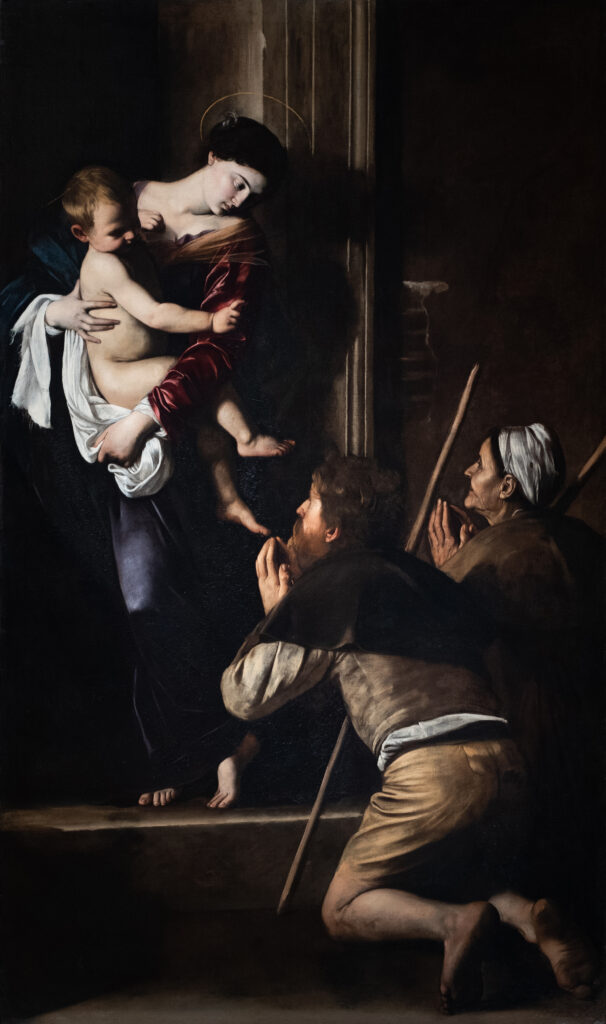
“Madonna di Loreto”, Caravaggio, 1604–06, Cavalletti Chapel, Church of Sant’Agostino, Rome.
A man and a woman kneel before a mother and child. Their sticks suggest that they are pilgrims and, judging by their clothes, very poor. Caravaggio painted this for the Church of Sant’Agostino in Rome, which was the second-last stop for pilgrims making their way to St Peter’s. Such people — the mother, the child, the pilgrims — were a common sight on the streets of Rome. There are two odd things: the child’s size and the woman’s halo. Given his size, the boy should be too heavy for the mother to hold so effortlessly, and why is he naked? This is the Madonna of Loreto, standing on the doorstep of the house in Nazareth where she and St Joseph raised Jesus. But Caravaggio’s vision of the Madonna and Child is quite unlike any other. She is beautiful and monumental, yet she is not much different from the ordinary women who could be seen in the streets around the Church of Sant’Agostino. Only her halo shows forth her holiness. Perhaps the child’s nakedness refers to the practice of showing the child naked in scenes of the Nativity, underlining for the viewer the full humanity of Jesus. Perhaps the child’s size allows for the period of time the family spent in Egypt. They are now back in Nazareth and the child has grown. The doorstep might be Roman in style, but in fact it looks remarkably like the doorstep of the Holy House of Loreto. There was a traditional belief that angels had transported the home of the Holy Family from Nazareth to the Italian town of Loreto. By the time of Caravaggio, the Holy House had been enclosed in marble, around which a large basilica had been built, and the town had become a popular centre of pilgrimage. A wealthy Roman couple, who shared this devotion to the Madonna of Loreto, had commissioned this painting to hang in their private chapel just inside the door of San’Agostino, where it would be seen by ordinary pilgrims as they neared their journey’s end. Although these patrons were pleased with Caravaggio’s work, there were many in Rome who were shocked by it because his Madonna was barefoot and looked like a common woman from the surrounding city streets. Usually, artists showed the Madonna as Queen of Heaven with a perfectly proportioned child on her lap. Here she holds him as she stands in a doorway. It was common practice to show the patrons kneeling before her. But this poor couple are not patrons. They are just two humble and elderly peasants who, as they finish their pilgrimage, and perhaps their lives, are honoured with a vision of the Madonna and her child Jesus. Their humility is emphasised by the sight of dirty feet. Today we celebrate the Solemnity of the Assumption of Our Lady into Heaven. In Caravaggio’s painting, she and her child descend from heaven with bodies as real as our own. Surely, this painting is about how God’s graces are to be received? It is not the proud and haughty, but the lowly, whom he will raise up. This is Mary’s Magnificat, played out on a dark and dusty Roman street.
The Catholic Chaplaincy serves the students and staff of the University of Edinburgh, Edinburgh Napier University and Queen Margaret University.
The Catholic Chaplaincy is also a parish of the Archdiocese of St Andrews and Edinburgh (the Parish of St Albert the Great) and all Catholic students and staff are automatically members of this parish.


Follow us for news updates and inspiration. Website design by Colour Rich
St Albert's Catholic Chaplaincy is part of the English Province of the Order of Preachers, a charity registered in England and Wales (231192) and in Scotland (SC039062).