
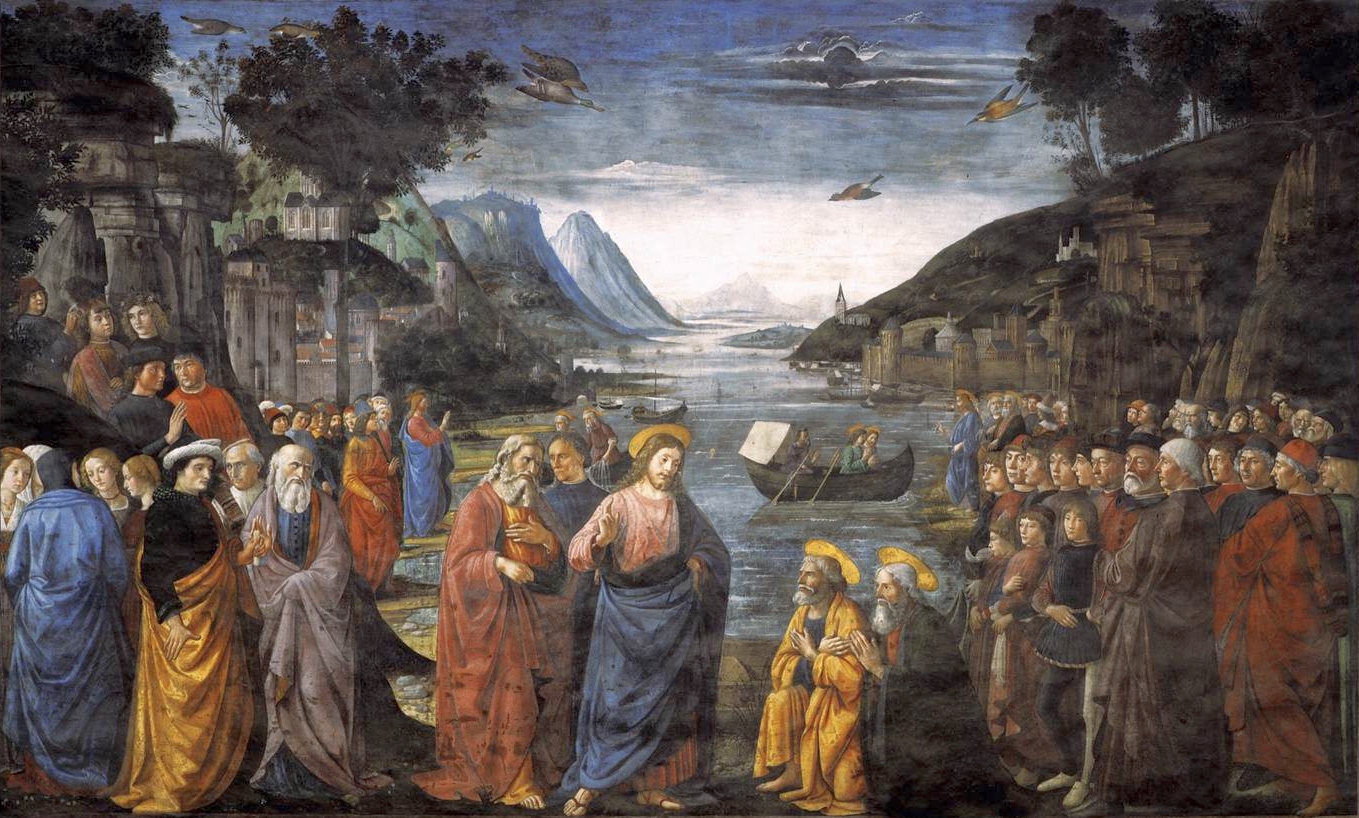
“Vocation of the Apostles”, Domenico Ghirlandaio, c. 1481, North wall, Sistine Chapel, Vatican.
The Apostles Peter and Andrew kneel before Christ wearing cloaks. They are ready to follow Christ. They are shown barefoot. Later on in the gospel he will send them out, saying: “Take no gold, nor silver, nor copper in your belts no bag for your journey, nor two tunics, nor sandals nor staff” (Mt 10:10). The earlier scene when Christ said to them “follow me” is shown behind them. On the opposite side, we see them for a third time. Now they accompany Christ as he calls James and John. Those brothers are shown in a boat with their father Zebedee mending their nets. Looking at this fresco in isolation, and noting the dominance of the body of water, you might make the the link between following Christ and baptism. But this fresco is not meant to be seen on its own. This is one of a sequence of gospel scenes painted on the north wall and each scene corresponds to the scene opposite on the south wall from the life of Moses. The fresco on the south wall directly opposite this one shows Moses and the people of Israel, when they have crossed the Red Sea dry shod, watching Pharaoh and his soldiers drown. Their crossing the Red Sea dry shod and their deliverance from Egypt foreshadows baptism. Pope Sixtus IV founded he Sistine chapel in 1471. He was a Franciscan friar and a noted scholar. He became the head of the Order in 1464, then a Cardinal, and, finally, was elected Pope. The scenes from the life of Christ have a particular focus on St Peter as you might expect in the chapel of his successor. But the focus on Moses was intended to draw a parallel between Moses and Christ as givers of the old written Law and the new Law of the Gospel, respectively. In all probability, it was Sixtus IV himself who specified the content of the fresco cycles on both walls. It is said that he continued to wear his Franciscan habit as Pope and was buried in it. His devotion St Francis and to the Franciscan Order is evident in this cycle of frescoes. These frescoes need to be seen through Franciscan eyes. St Francis and the Order represented a return to the golden age of the early Church and St Francis was Christ-like in a very strong sense, something which his stigmata confirmed. It was Pope Sixtus who canonised the Franciscan theologian St Bonaventure in 1482. In his writings, St Bonaventure had compared St Francis both to Moses and Christ. He adapted the language of the Exodus to compare his Order to the promised land, and the world the friars had left behind to the slavery of Egypt. He wrote, “The cross of Christ will part the waters of the sea for them like Moses’ rod and they shall traverse the desert to the promised land of the living, where they shall enter by the miraculous power of the Cross, having crossed the Jordan of our human mortality”. Perhaps this promised land, which is the life of the world to come, is just visible then, bathed in a light filled distance haze at the very centre of Ghirlandaio’s fresco.
The Catholic Chaplaincy serves the students and staff of the University of Edinburgh, Edinburgh Napier University and Queen Margaret University.
The Catholic Chaplaincy is also a parish of the Archdiocese of St Andrews and Edinburgh (the Parish of St Albert the Great) and all Catholic students and staff are automatically members of this parish.


Follow us for news updates and inspiration. Website design by Colour Rich
St Albert's Catholic Chaplaincy is part of the English Province of the Order of Preachers, a charity registered in England and Wales (231192) and in Scotland (SC039062).