
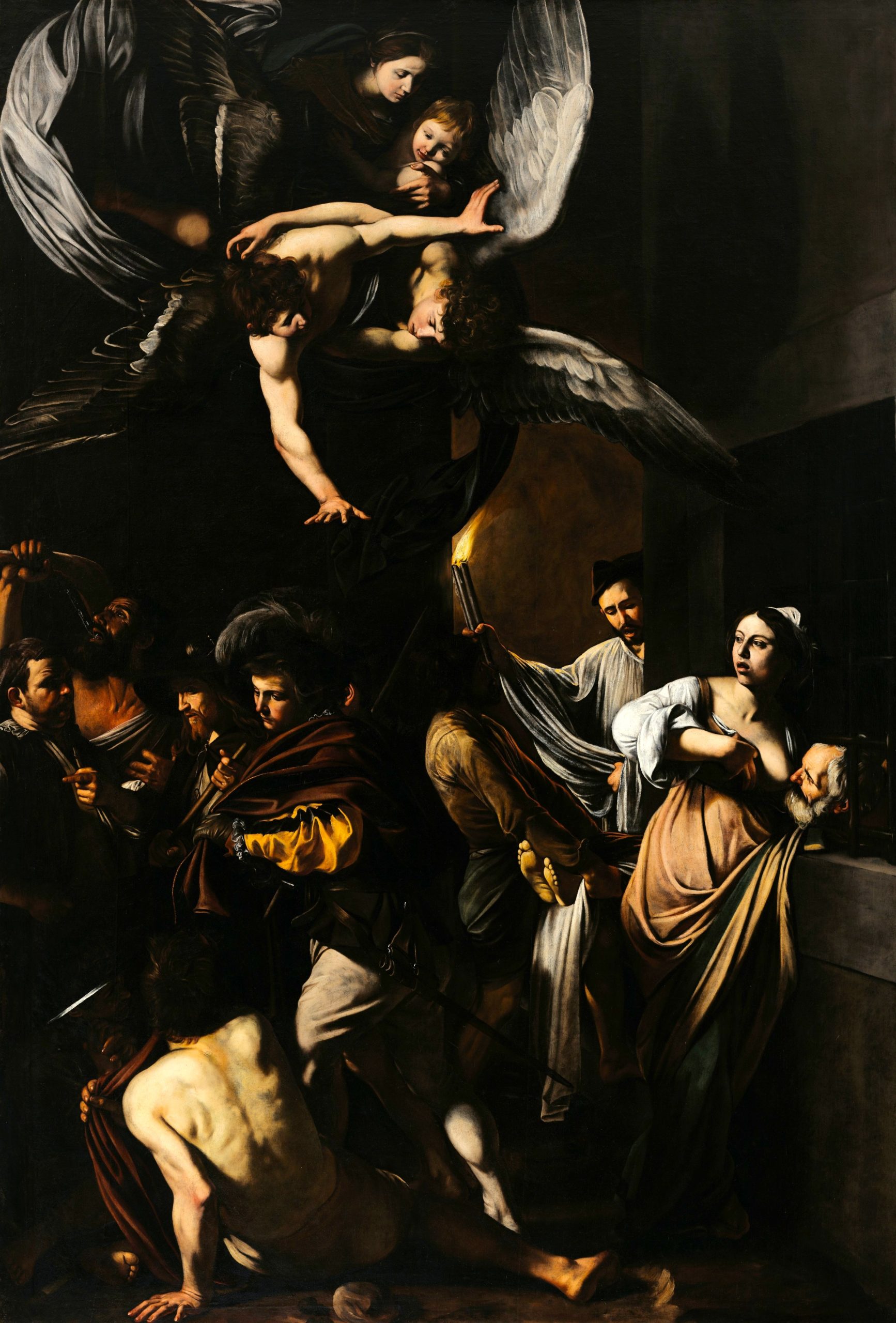
“The Seven Acts of Mercy”, Caravaggio, 1606/07, Chiesa Pio Monte della Misericordia, Naples.
This is Caravaggio’s version of Mary as the Mother of Mercy. Usually, artists showed Mary as the mother of mercy with a cloak spread out with people sheltering beneath, but Caravaggio shows Mary looking down from heaven on individuals as they do the works of mercy. The commission came from the lay confraternity of the Pio Monte della Misericordia, which had been founded in 1601 by seven young nobles. Normally, such charitable groups focused on a particular act of mercy but the constitution of this group stated that their aim and purpose was to perform all of the seven acts of the mercy. In this painting, Caravaggio gives a visual expression to this constitution by showing each of the seven acts of mercy being carried out on a Neapolitan street at night. The doers of mercy catch the light and so stand out in the darkness, so that their light shines before men as in today’s gospel text. Above them Mary holds the child Jesus as they look down on all that is happening below on the street. Caravaggio transforms her cloak into a winding length of cloth. It also catches the light and could be a sheet hung out to dry high above the street, that is suddenly caught and twisted by a gust of wind, which blowing this way and that evokes the Holy Spirit, who Christ compared to a wind that blows where it wills (Jn 3:8). The winding cloth and the wings of the two angels seem to rotate, giving visual expression to the dynamism of the Spirit descending upon our world. But these heavenly figures are as real as those below and are lit by the same light and cast real shadows. God’s heavenly mercy is being enacted on the earth below. Caravaggio manages to show all seven acts of mercy, although it is fair to say that some are harder to see than others. On the far left an inn keeper welcomes the stranger as he gives a pilgrim lodging for the night. Behind him Samson drinks water from the jaw bone of an ass, as once God quenched his thirst in the desert. In front of the pilgrim a young well-dressed man divides his cloak in two with blade of a sword. Half of the torn cloak is grasped by the man on the ground whose bare back catches the light. This is a latter day St Martin who did the same and then was told in a dream that the poor man was Christ. To the left of this almost naked man, two figures crouch in the shadows. You can just see a foot and an ear. They represent the sick. The young man can see them and presumably is visiting them. More easily seen is the man on the right carrying out a corpse for burial. We clearly see the feet and the shroud. Behind him a priest lights the way with a torch. Finally, on the far right we see the figure of Pero from Roman mythology as she feeds her imprisoned father Cimon from her breast, and so she both visits the prisoner and feeds the hungry. Usually, the acts of mercy were shown separately but here Caravaggio skilfully shows all seven happening together on a single narrow street at night. Heavenly light descends into a darkened streets of Naples, picking out individuals engaged in acts of mercy. The angels, the naked back, and the woman offering her breast, are the bright points of a triangle, through which the of fabric of human living is woven, connecting each deed with the billowing sheet above. This is real life in Naples as it was, under Spanish rule: an overcrowded city with massive poverty, where people died on the streets and prisons were terrifying. But Caravaggio, in line with his patrons’ wishes, shows a different Naples. It is one where mercy holds sway, and where good deeds shine in the sight of men and so give glory to the Father in heaven.
The Catholic Chaplaincy serves the students and staff of the University of Edinburgh, Edinburgh Napier University and Queen Margaret University.
The Catholic Chaplaincy is also a parish of the Archdiocese of St Andrews and Edinburgh (the Parish of St Albert the Great) and all Catholic students and staff are automatically members of this parish.


Follow us for news updates and inspiration. Website design by Colour Rich
St Albert's Catholic Chaplaincy is part of the English Province of the Order of Preachers, a charity registered in England and Wales (231192) and in Scotland (SC039062).