
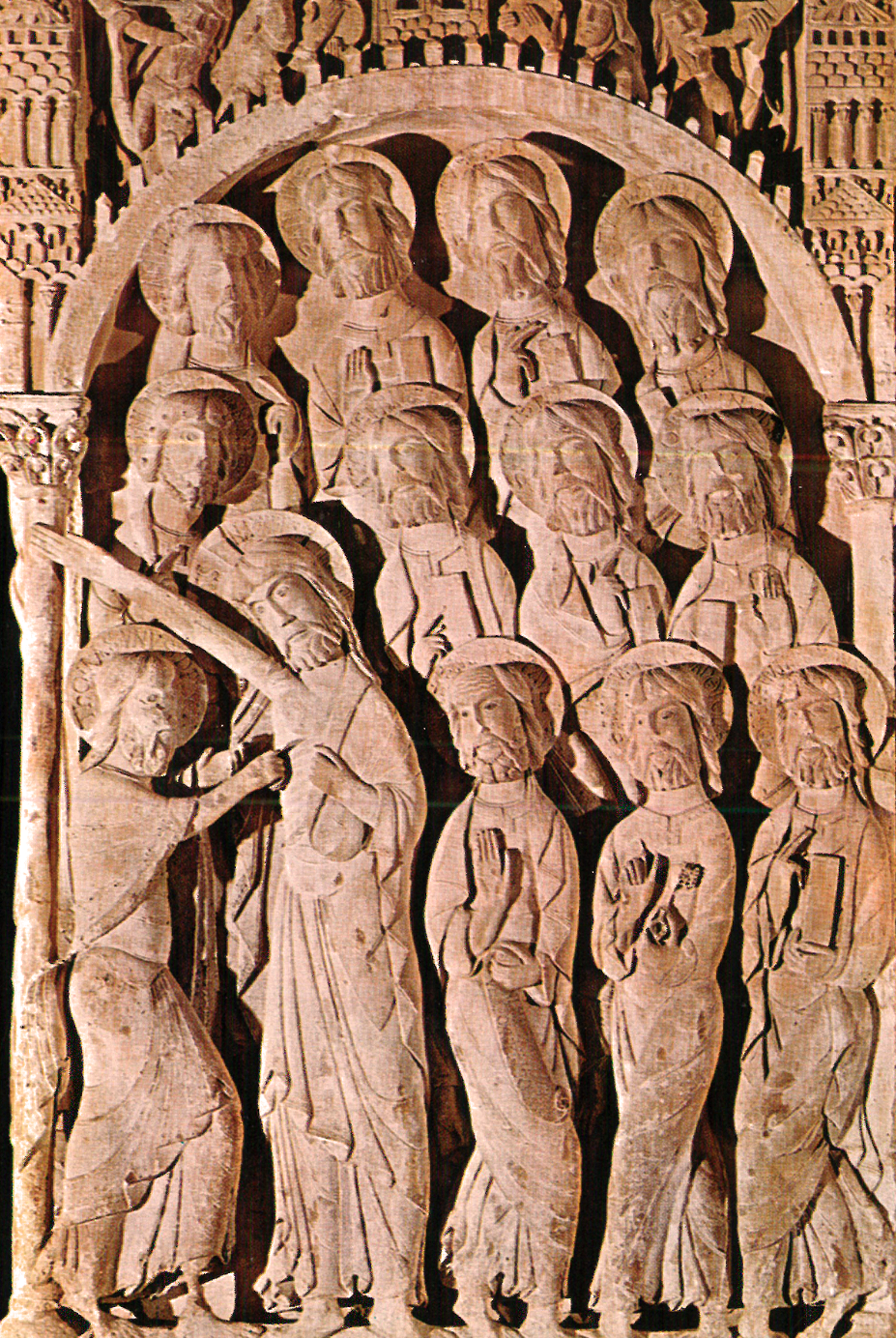
“The Doubt of St Thomas”, late 11th Century, Lower Cloister, Real Abadía de San Domingo de Silos, Burgos, Spain.
This relief carving, entitled “The Doubt of St Thomas”, comes from a corner pillar of the lower cloister at the Abbey of San Domingo de Silos. Christ’s posture with his arm held up straight can be found in many other medieval illustrations of the scene. But what is more interesting here is the way the whole group is shown. They are arranged as an ordered way. Their heads are all inclined towards St Thomas. The Risen Jesus also directs his gaze at him. There is a strong sense of unity. The whole group represents the Church united in St Thomas’ declaration of faith: “My Lord and My God”. The names of the individual Apostles are incised into their haloes. If you count them you will find that there ate twelve and not eleven. This is because the sculptor has included St Paul next to Jesus, which might be surprising as St Paul was not there and had not yet come to believe in Christ. Beside him stands St Peter holding his key. Although the focus of the composition is on St Thomas touching the wound in Jesus’ side, actually Sts Peter and Paul are at the centre of the front row. Of course, they are respectively, the Apostle to the Jews and the Apostle to the Gentiles, so that together they represent the universal mission of the Church. This powerful image is on the same pillar as the “Disciples at Emmaus”, where two disciples are shown with the Jesus. But in the cloister, it is part of a series of eight reliefs on the four corner pillars showing also the Death, Resurrection, the Ascension of Jesus, Pentecost, as well as the Tree of Jesse with the Annunciation and the Crowning of Our Lady as Queen of Heaven. In the scenes of Ascension and Pentecost the Apostles are arranged in a similar way to this relief, emphasising the unity of the Church. If you ever get the chance to visit the Cloister of the Abbey of San Domingo de Silos, please take it. These reliefs are wonderful!
The Catholic Chaplaincy serves the students and staff of the University of Edinburgh, Edinburgh Napier University and Queen Margaret University.
The Catholic Chaplaincy is also a parish of the Archdiocese of St Andrews and Edinburgh (the Parish of St Albert the Great) and all Catholic students and staff are automatically members of this parish.


Follow us for news updates and inspiration. Website design by Colour Rich
St Albert's Catholic Chaplaincy is part of the English Province of the Order of Preachers, a charity registered in England and Wales (231192) and in Scotland (SC039062).