
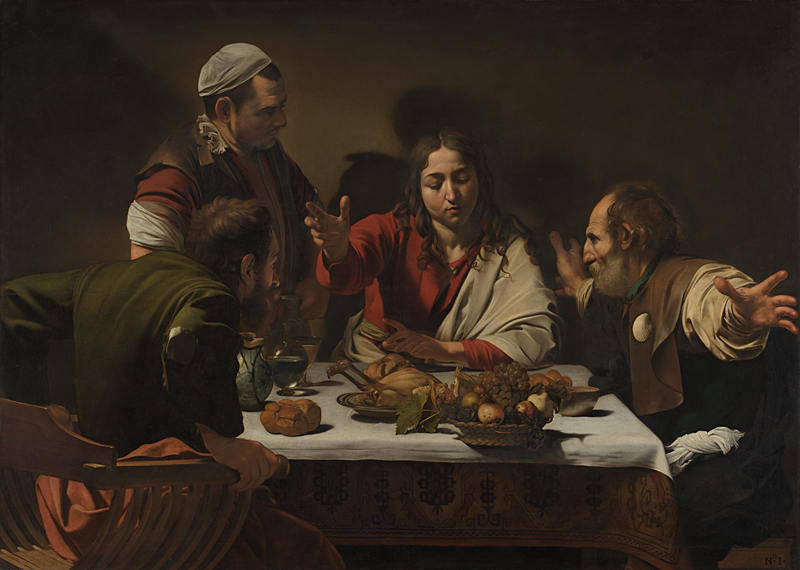
The Supper at Emmaus, Michelangelo Merisi da Caravaggio, 1601, National Gallery London.
Caravaggio painted this for the wealthy art collector, Ciriaco Mattei. In the Palazzo Mattei, the naturalism of this work would have been striking and perhaps most significantly, it would have challenged the contemporary tendency to idealise scenes from biblical and mythic narratives. Just think of how Michelangelo and Raphael painted 50 years before. Set against the eternal spring of Renaissance art, and the grandeur of its settings, Caravaggio shows the supper taking place in what looks like a rather common Roman tavern. But this is Counter Reformation art in which recognisable and realistic details of ordinary life were intended to lead the viewer to engage with and mediate on the mysteries of Christ’s life. Notice some of the details. For example, one of these disciples wears a pilgrim’s shell, so the viewer would connect the gospel scene with contemporary pilgrimage. The two disciples and the innkeeper are in contemporary dress. While this setting might have been thought to lack decorum, Caravaggio’s realism spoke to many. One biographer’s criticism was that the fruits in the basket were autumnal, whereas it had actually happened in Spring, that is the time of Passover and Easter. Despite this the fruit are marvellously real. They even show signs of decay, which also must have been deliberate and is, perhaps, significant. Caravaggio painted what he saw before him in the studio, but he did select and carefully pose what he saw. It was said that he carefully controlled the fall of light in the studio space. Notice how light reaches the faces of the two disciples but the inn keeper’s face is in shadow. In this painting the majolica jug, the glassware, the table cloth and the oriental rug might have been his own or that of his patron, and may have had a resonance now lost to us. But this realism is selective. Here the great gesture of the disciple on the right with arms outstretched is a very powerful evocation of the cross. His method of posing figures in a studio and then painting from a particular vantage point is used to great effect here. We look down on the table as if we are standing before it. We are not seated but there is room at the table! The elbow of the disciple on the left almost enters our space. As has been often remarked, you want to reach forward and push in that basket of fruit! All of these elements and many others come together to evoke this moment of recognition and the birth of faith in his soon to be unseen presence. In this passage they recognised him in the breaking of bread. In other passages recognition came when he showed them his wounds. Notice that that his hands are posed in such a way that the wounds made by the nails are all but concealed so that the focus is on the gesture of blessing the bread. It rather poignant to note that when Caravaggio painted this he was at the height of his career. But this high point in his life was as precarious as the basket of fruit on the table’s edge. Most probably, he had no idea of the tragedy which would characterise the reminder of his days and see him dead within a decade. For me this painting of the Supper at Emmaus is all the more eloquent because he didn’t know what was ahead. Could he have known that he himself was working in a moment of favourable light, which darker forces, from both within and without, along with some level of contingency, would extinguish? For me this evokes what faith in Christ ’s unfailing presence really is in our lives.
The Catholic Chaplaincy serves the students and staff of the University of Edinburgh, Edinburgh Napier University and Queen Margaret University.
The Catholic Chaplaincy is also a parish of the Archdiocese of St Andrews and Edinburgh (the Parish of St Albert the Great) and all Catholic students and staff are automatically members of this parish.


Follow us for news updates and inspiration. Website design by Colour Rich
St Albert's Catholic Chaplaincy is part of the English Province of the Order of Preachers, a charity registered in England and Wales (231192) and in Scotland (SC039062).