
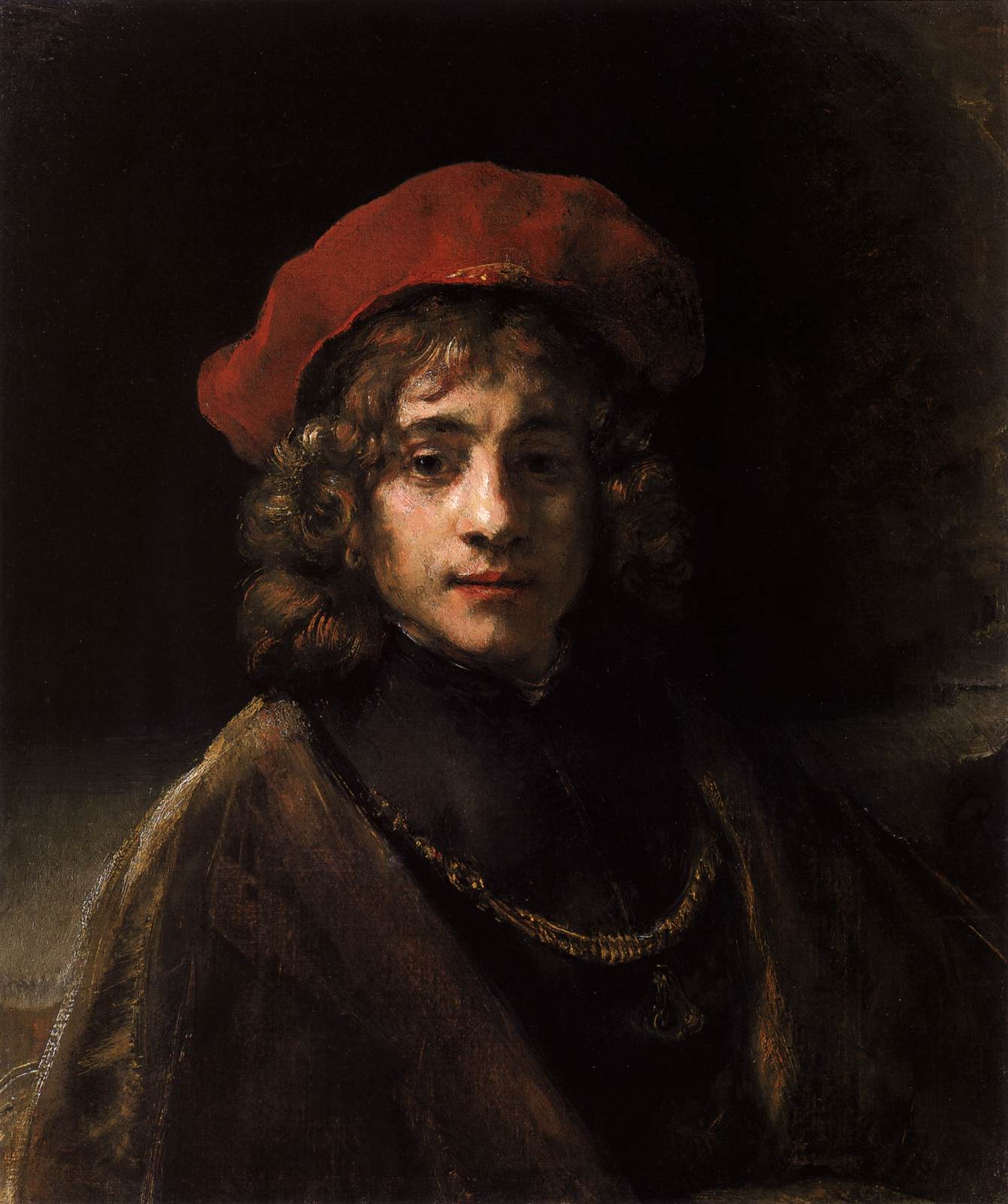
 “Titus, the Artist’s Son”, Rembrandt c. 1657, The Wallace Collection, London.
This portrait, which Rembrandt made of his son, Titus, is generally dated to about 1657, which would make Titus 16 years old. Titus was the only one of four children to survive and his mother died when he was an infant. Rembrandt was a very successful as an artist, but he spent lavishly. Around the time he painted this portrait, Rembrandt was declared bankrupt. Because he was bankrupt, Rembrandt was no longer competent to manage his business affairs, so it was left to his mistress and to his son Titus to manage the sale of his paintings and the production of his etchings. In this painting, Titus is a boy in a man’s clothes. The gold chain and the heavy coat was the dress of a prosperous Venetian merchant. For me me this is the first clue to what the portrait is about. He painted his son several times, but none of the other portraits have the searing poignancy of this work. Light falls from the left onto the bright red beret with its gold trim. It catches the back of his shoulder, so you notice the rather grand coat and the gold chain. These fine clothes are not let fade into the shadows. Why has he dressed his son up in such expensive clothes at the very time when they are almost penniless? Is it an expression of hope for the boy’s future? Or is it something else? The light catches the curls of hair which frame his young face. The hair is so beautifully painted that you could almost touch it. Whenever, I have stood and looked at this painting, I have been transfixed by his eyes. For me, there is within them a sadness for what has been lost and yet there is also a sense that Titus isn’t fully aware of the tragedy that has befallen him. This knowledge awaits him still. He is a boy whose father’s circumstances forced him to act as an adult. At this stage, it is very likely that Rembrandt himself would have had a huge sense of his own financial failure. And yet what is so obvious to me is the tender love with which he paints his son. What I see is a father asking forgiveness both of his son and of himself. So to my mind he paints not just his son, but also their relationship in a way which is startlingly honest. I connect it with John’s gospel, for in the Son you see the Father and in the seeing is manifest the bond of love between them. What is so moving for me about this painting is that this trinity of love is dressed for us in the garments of human frailty, failure and the contingencies of a human life.
The Catholic Chaplaincy serves the students and staff of the University of Edinburgh, Edinburgh Napier University and Queen Margaret University.
The Catholic Chaplaincy is also a parish of the Archdiocese of St Andrews and Edinburgh (the Parish of St Albert the Great) and all Catholic students and staff are automatically members of this parish.


Follow us for news updates and inspiration. Website design by Colour Rich
St Albert's Catholic Chaplaincy is part of the English Province of the Order of Preachers, a charity registered in England and Wales (231192) and in Scotland (SC039062).