
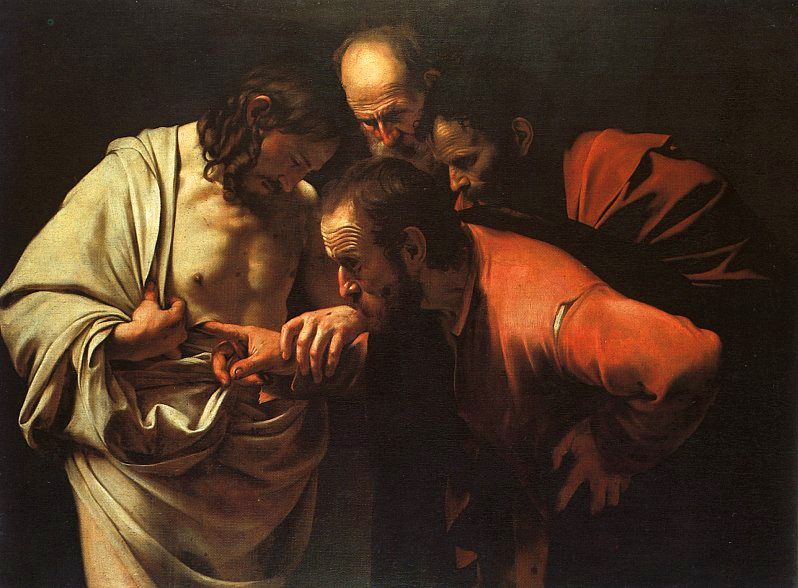
“Incredulity of St Thomas”, c. 1601/02, Caravaggio, Bildergalerie, Schloss Sanssouci, Potsdam, Germany.
On Friday we celebrate the Feast of the Apostle St Thomas, remembered above all as “Doubting Thomas”. Caravaggio’s image of the saint placing his finger into the wound in Christ’s side is perhaps the most famous representation of him in Western art. Yet when it was painted as a private commission in Rome, it must surely have startled those who first saw it. There was nothing quite like it in the city, and in several important respects it departed sharply from what Roman viewers were used to seeing. For one thing, the subject itself was unusual in Rome. The Holy City had no strong tradition of devotion to St Thomas, and so this Gospel scene was not one that Roman worshippers or collectors would commonly have encountered. Caravaggio came from the north and may have known earlier versions of the subject from the artistic centres of northern Italy. But he was unlikely to have found anything comparable in a Roman church or collection. His treatment of the scene was strikingly new. Artists usually showed the eleven disciples gathered in a closed room, with Christ and Thomas at the centre. Caravaggio strips the story down to its essentials: Christ, Thomas, and two other apostles, pressed together in an undefined space. Like a photographer moving in for a close-up, he brings us almost uncomfortably near to the action. Christ not only permits Thomas to touch the wound; he guides the apostle’s hand into it. The realistic detail is astonishing. Light catches the saint’s finger and even the small flap of skin raised by his touch. There is no blood, but the image is intensely visceral. Before Caravaggio, no one had made the wound the focus of the scene with such force. All four figures stare at Thomas’s finger as it enters Christ’s side. Light falls from above, picking out the top of Thomas’s hand and index finger, while also illuminating Christ’s hand as it gently directs him. Their facial expressions deepen the drama. The furrowed brows of the apostles suggest amazement: not only that Christ’s risen body is real flesh, but that he allows this intimate and searching contact. Christ’s own face, partly veiled in shadow and shown with parted lips, suggests the tenderness of the wound itself. It is little wonder that this became the most frequently copied of Caravaggio’s paintings.
The Catholic Chaplaincy serves the students and staff of the University of Edinburgh, Edinburgh Napier University and Queen Margaret University.
The Catholic Chaplaincy is also a parish of the Archdiocese of St Andrews and Edinburgh (the Parish of St Albert the Great) and all Catholic students and staff are automatically members of this parish.


Follow us for news updates and inspiration. Website design by Colour Rich
St Albert's Catholic Chaplaincy is part of the English Province of the Order of Preachers, a charity registered in England and Wales (231192) and in Scotland (SC039062).