
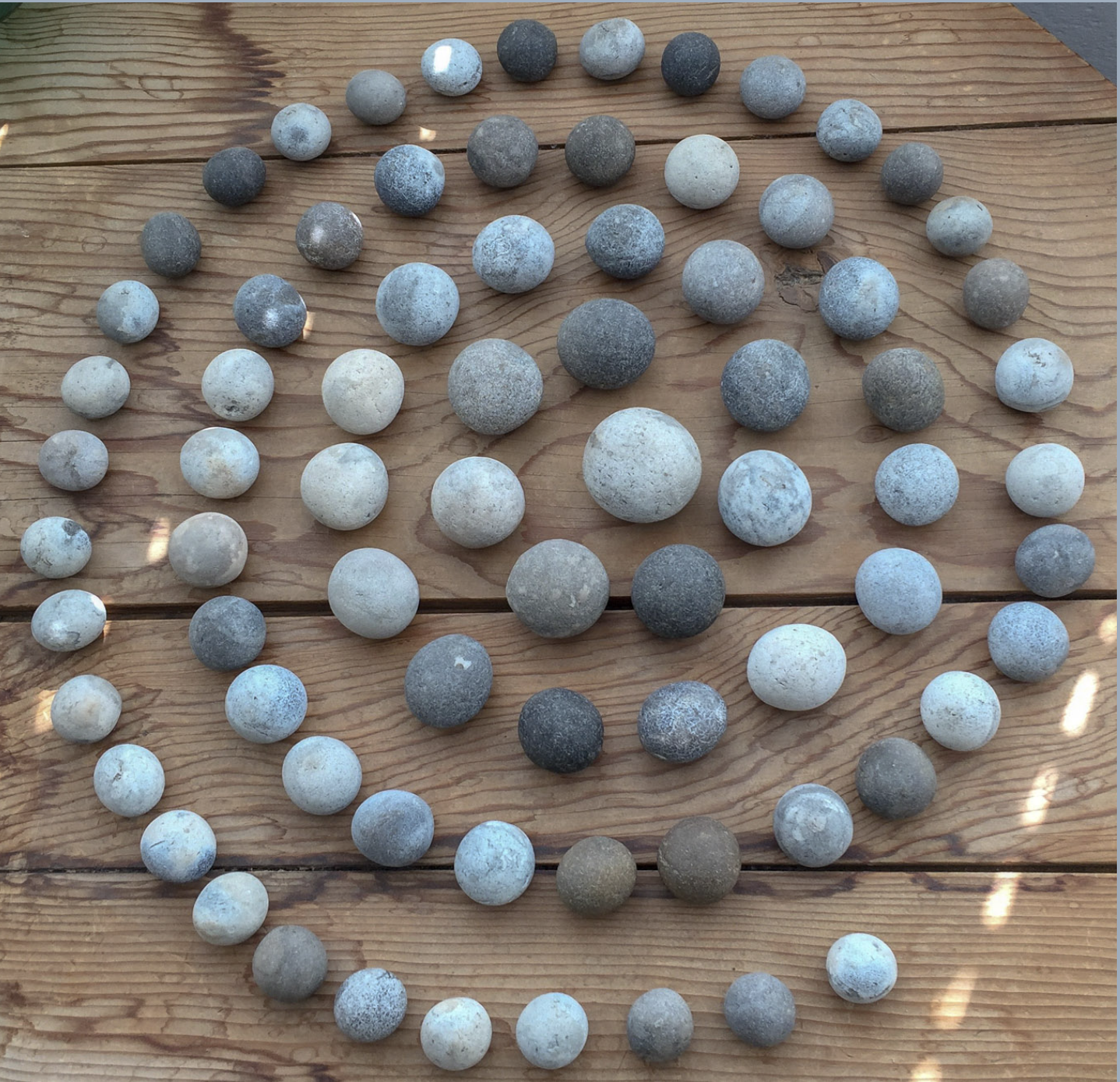
“Spiral of Stones” Jim Ede 1958, Kettle’s Yard, Cambridge.
Kettle’s Yard is the name given to four interconnected cottages which Jim Ede (1895 – 1990) converted to house his art collection, which includes works by David Jones, Ben Nicholson, Winifred Nicholson and others. In 1966 he handed it all to Cambridge University, establishing it as an art gallery. Then in 1973 he retired to Edinburgh where he ended his days. He called his guide to Kettle’s Yard “Way of Life” and if you visit Kettle’s Yard you will understand this title because Kettle’s Yard embodies a whole way of living. In each room, as well as works of art, he placed found objects, each one considered and carefully positioned. In about 1958 Jim Ede arranged 76 limestone pebbles in a spiral on a table in Kettle’s Yard. He liked stones and pebbles and had picked these stones at Cley on the Norfolk coast. In September 1958 he wrote in a letter, “In our quiet life there is little to report, save that we are now in a little cottage half a mile from the Norfolk sea – a shore full of and overfull of pebbles – I can’t resist bringing back a load each day – we are to be here 2 weeks and expect it will do us both oceans of good.” And years later: “These are pebbles I picked up on a Norfolk beach. You have no idea how hard it is to find a really spherical pebble, round as a bullet ball, one of which we have at Kettle’s Yard. I made this spiral in 1958, really as a way to see the stones without taking up too much space. Perhaps an exemplar of necessity as the mother of invention. Now in 1973, I hear that a sculptor has hit the news with an exhibition of cement spheres on a large scale, arranged in this fashion.” He began with the biggest and placed them in order of decreasing size. Each individual stone was carefully chosen. Each was shaped by the ocean, made almost spherical by water. Each carries within itself the energy of millennia. This arrangement of stones as a spiral draws attention to each individual stone and its relationship to the other stones and to the whole. Maybe Jim Ede could see in each pebble some level of kinship with ourselves, as the individuals we have become, and the network of relationships within which we live and the histories by which we have been shaped. And yet just like a pebble on a beach, at the core of each of us is this person created in the image and likeness of God and yet utterly unique. I often think that our chapel has something of the spirit of Kettle’s Yard about it, in the considered choice of objects and materials; and to some extent their arrangement, but above all in the sensitivity to the play of light. It is a balancing of various relationships: aesthetic, religious and cultural. Some writers have termed it “alchemy”, but perhaps this is because they did not have the language of faith. Here a rich tradition of faith surfaces rather beautifully in contemporary dress.
The Catholic Chaplaincy serves the students and staff of the University of Edinburgh, Edinburgh Napier University and Queen Margaret University.
The Catholic Chaplaincy is also a parish of the Archdiocese of St Andrews and Edinburgh (the Parish of St Albert the Great) and all Catholic students and staff are automatically members of this parish.


Follow us for news updates and inspiration. Website design by Colour Rich
St Albert's Catholic Chaplaincy is part of the English Province of the Order of Preachers, a charity registered in England and Wales (231192) and in Scotland (SC039062).