
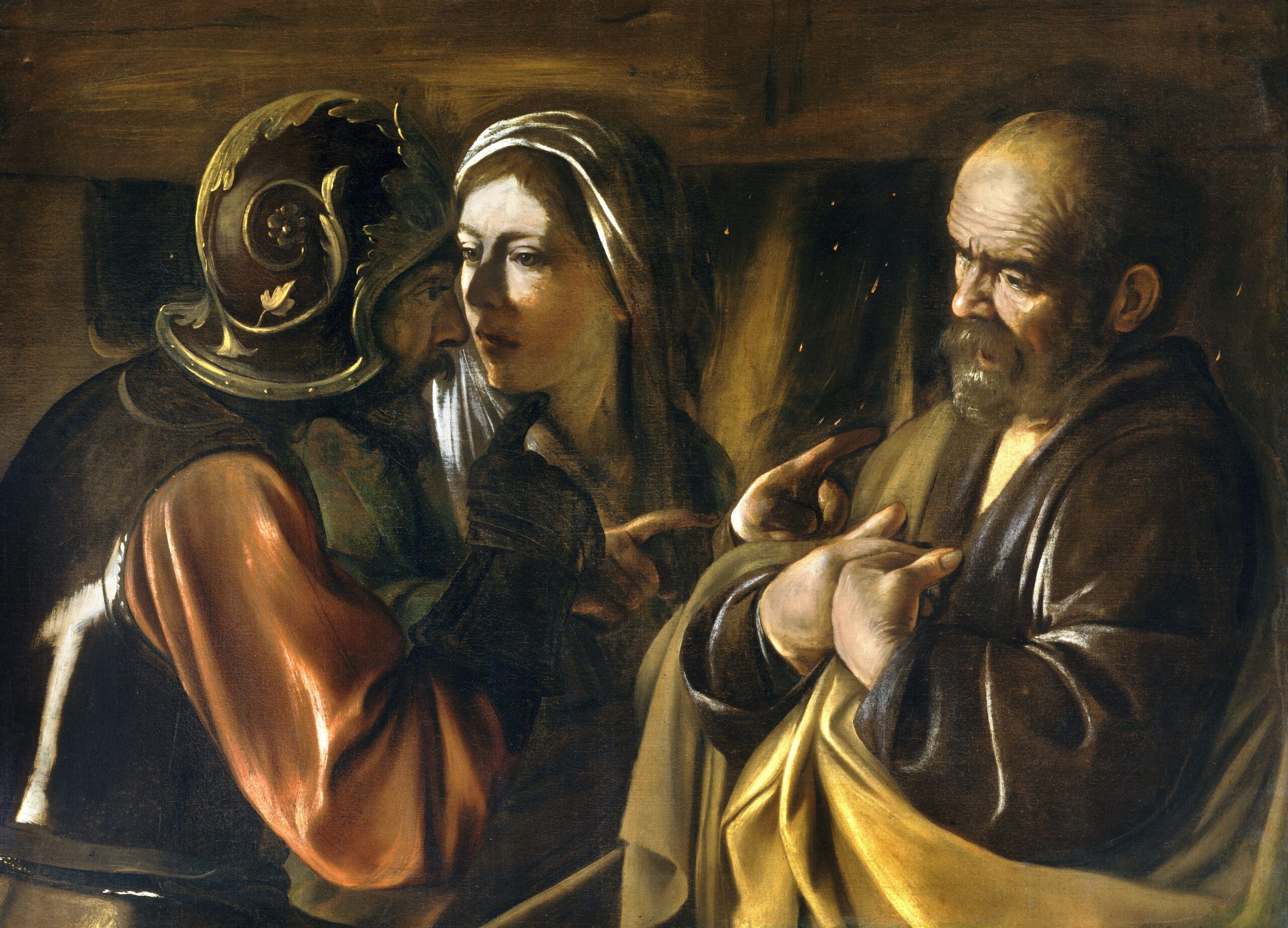
“Denial of St Peter” 1610, Caravaggio, Metropolitan Museum of Art, New York.
After the arrest of Jesus, St Peter stood outside in the High priest’s courtyard, warming himself by a charcoal fire. A servant girl said to him, “You also were with the Nazarene, Jesus” (Mk 14:67). He denied it. But then she said it to some bystanders. For the second time, St Peter denied it. Finally, the bystanders said it to him as well and, for the third time, he denied knowing Jesus. This time he swore, “I do not know this man of whom you speak” (Mk 14:71). Then the cock crowed for the second time and St Peter remembered the words of Jesus, “Before the cock crows twice you will deny me three times.” Mark says that then St Peter broke down and wept (Mk 14:72). In this picture, Caravaggio includes elements of all three denials and, indeed, St Peter’s tears. The fire is suggested in the background with a few flecks of bright pigment. But it is the hands of the three characters that tell the story, and with great economy. The servant girl turns to look at the bystander but points towards St Peter. In fact, both of her hands point at St Peter. The third figure, whom we assume is a bystander, also points a finger at St Peter. In this way, all three denials are represented. St Peter’s hands are closed on his chest. Is this a gesture of denial or repentance? The finest part of the painting is the face of St Peter. Tears are beginning to form in his eyes. His look is one of immense sorrow. This may be one of the last works painted by Caravaggio. By September 1609, he was in Naples. Negotiations for a Papal pardon were also underway which, if granted, would allow him to return to Rome. It is thought that this painting was painted while he waited. He had been injured in a fight and experts say that the handling of paint in “The Denial of St Peter” shows a loss of manual dexterity, yet St Peter is portrayed with extraordinary power. Other artists showed St Peter’s repentance and his tears, but Caravaggio puts the focus on his denial, while not excluding the moment of repentance. This pivotal moment is subtly and very powerfully captured. It is perhaps even more powerful when you see in it evidence of Caravaggio’s own diminishment. St Peter, pray for us.
The Catholic Chaplaincy serves the students and staff of the University of Edinburgh, Edinburgh Napier University and Queen Margaret University.
The Catholic Chaplaincy is also a parish of the Archdiocese of St Andrews and Edinburgh (the Parish of St Albert the Great) and all Catholic students and staff are automatically members of this parish.


Follow us for news updates and inspiration. Website design by Colour Rich
St Albert's Catholic Chaplaincy is part of the English Province of the Order of Preachers, a charity registered in England and Wales (231192) and in Scotland (SC039062).