
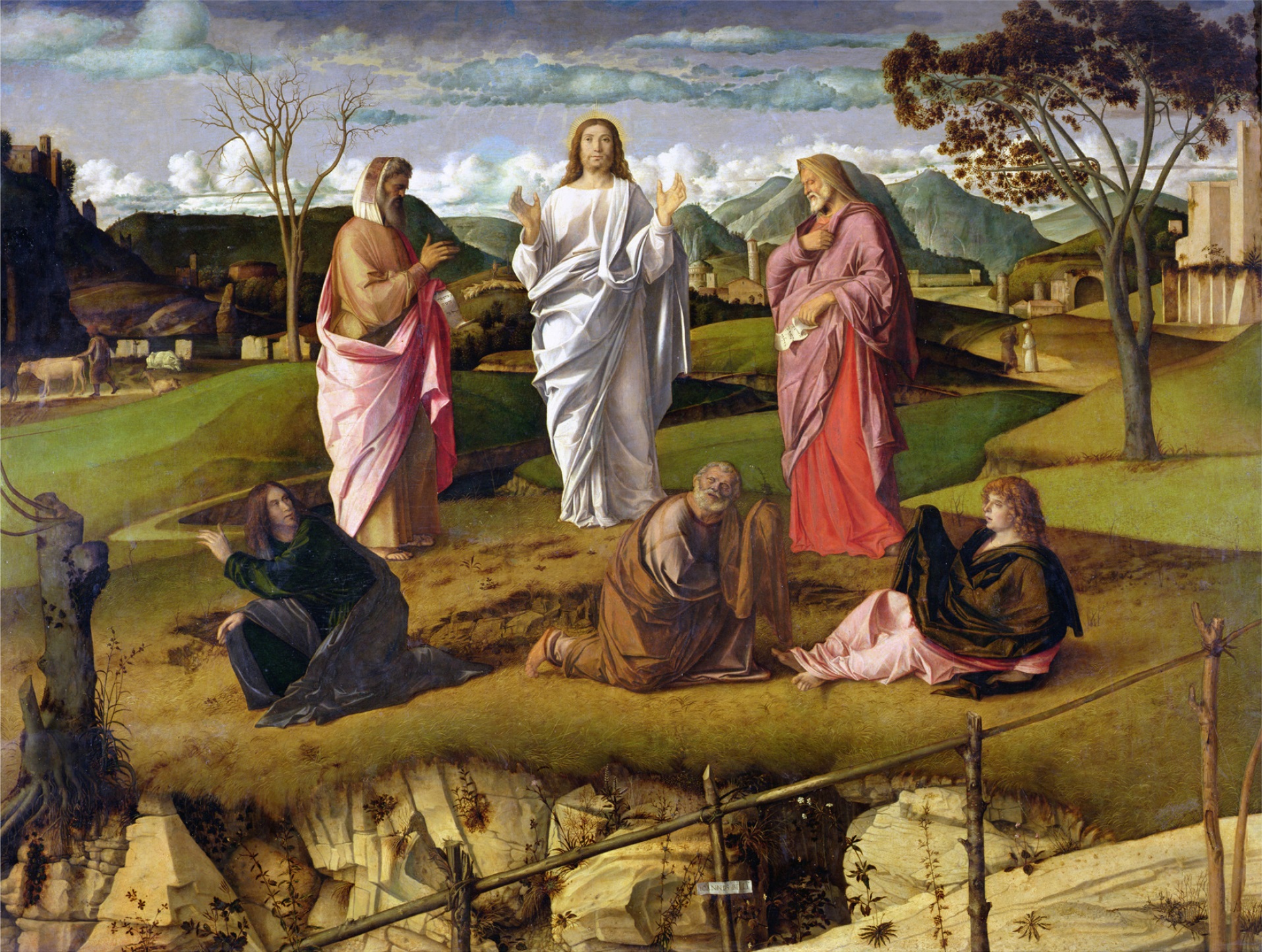
Christ’s clothes are as bright as the white clouds on the horizon behind him, yet they lack the intense luminosity suggested by the gospel accounts. His right hand casts a shadow as does the cloth of his garment. As always, Bellini is subtle. The bright clothes lead the eye to the bright clouds and they lead our thoughts to the moment when a bright cloud will descend upon them and the words spoken from heaven will ring in their ears: “This is my beloved Son, with whom I am well pleased; listen to him.” But on closer inspection, you can work out that the cloud is already there. The three disciples are not looking at Christ. They are listening to the heavenly voice. We must assume then that they are within the bright cloud. The light, which shines upon Jesus, Moses and Elijah, is from a different source and is more intense that the diffuse daylight that illumines the landscape behind them. The three disciples do not yet comprehend who Jesus is or the full nature of his glory. They each look in a different direction, and it is, as if they hear the heavenly voice but they are trying to locate the speaker. But this is no mountain top. You can see the real mountain peaks in the distance. Nearby, there are settlements and pastures where animals graze and people walk and stop to talk to each other. Bellini creates a subtle distinction between the foreground area where the disciples are, and where the transfiguration happens, and the background where life goes on as normal. The event of the transfiguration is contained in this place “apart”. Christ stands behind and above the disciples. His face is serene. He looks like a Greek God or hero. He even stands in a classical contrapposto pose. By contrast, the three disciples are anything but serene or god-like. They do not stand but remain on the ground as if they had just fallen on their faces. Also Bellini has made them slightly smaller than Christ and his companions and by this simple device confuses the eye, suggesting that Christ and his companions are in a different space. Bellini’s always includes details which have symbolic meaning and are intended to lead the viewer into deeper mediation on the great mystery he depicts. For example, here the tree stump on the left may symbolise the passion to come, yet around it there are signs of new growth which would suggest the resurrection. There is a fence to the front. It runs along a path which rises up to give access to the raised ground. The fence serves to distance the viewer from the scene, but it offers also a subtle invitation to climb the path which seems to continue to the right, suggesting the onward journey to Jerusalem that awaits Christ and his disciples. It is this same path which in this Lenten season we are invited to follow.
The Catholic Chaplaincy serves the students and staff of the University of Edinburgh, Edinburgh Napier University and Queen Margaret University.
The Catholic Chaplaincy is also a parish of the Archdiocese of St Andrews and Edinburgh (the Parish of St Albert the Great) and all Catholic students and staff are automatically members of this parish.


Follow us for news updates and inspiration. Website design by Colour Rich
St Albert's Catholic Chaplaincy is part of the English Province of the Order of Preachers, a charity registered in England and Wales (231192) and in Scotland (SC039062).