
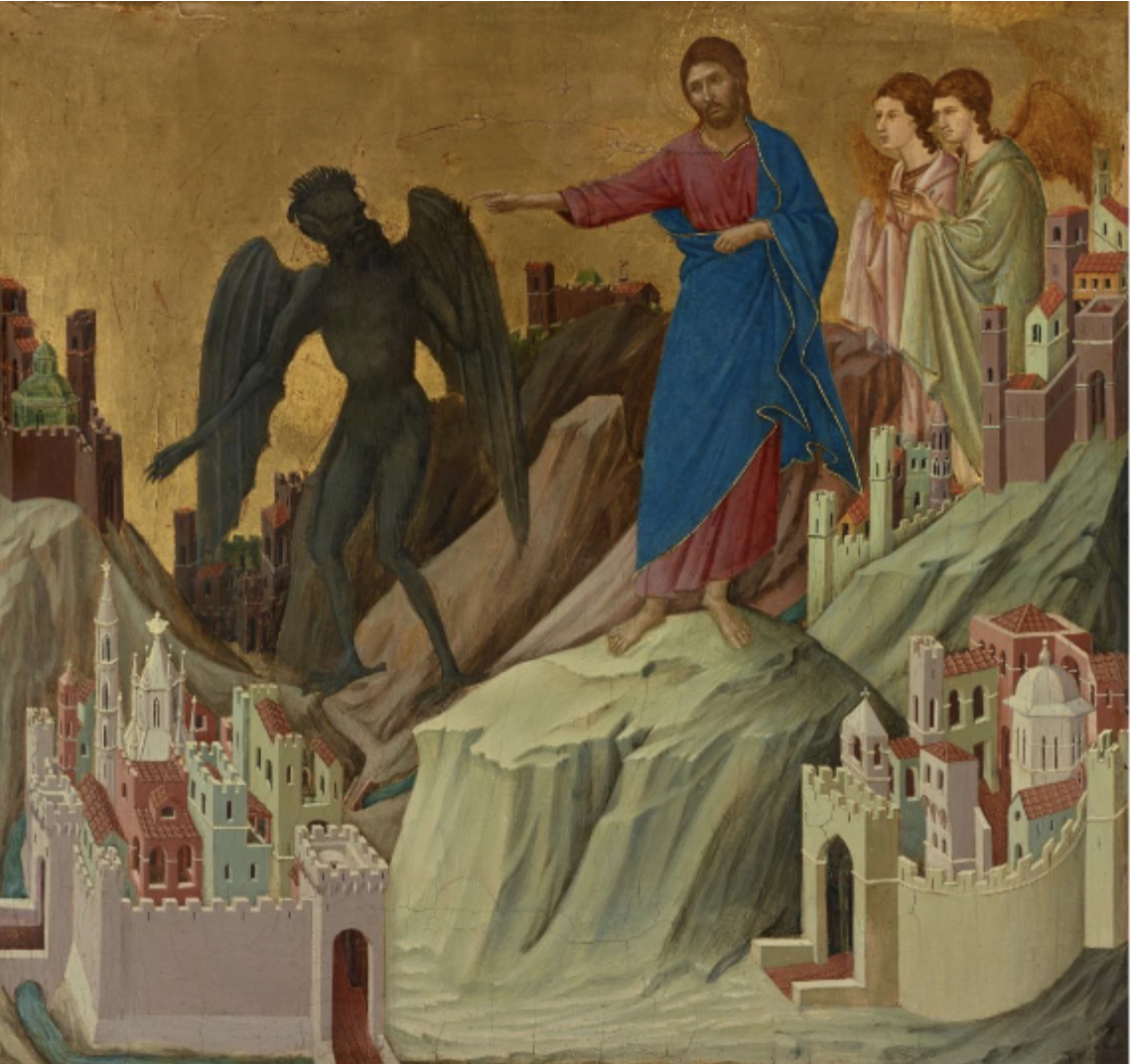
“Temptation of Christ on the Mountain”, Duccio di Buoninsegna, 1308–11, Frick Collection, New York.
This panel illustrates the third temptation from today’s gospel. “The devil took him to a very high mountain, and showed him all the kingdoms of the world and the glory of them; and he said to him, “All these I will give you, if you will fall down and worship me.” The panel was part of Duccio’s great altarpiece, the Maestà, which he painted for the Cathedral of Siena. It came from the base or predella to the rear of the altarpiece and was one of a sequence of scenes from the life of Christ. It was positioned chronologically between the second temptation in which the devil takes Christ to the pinnacle of the Temple and the call of Saints Peter and Andrew. In it Christ and the devil look like giants striding above the cities of the world, which look like toy towns. This difference in scale emphasises the significance of the dramatic confrontation between Christ and the devil. The gold background further suggests its importance. When Duccio was active, gold was used to show the heavenly realm and clearly, the devil has encroached on that realm. The gospels do not describe the devil, but Duccio’s contemporary Dante did. As in Dante’s poem, Duccio gives the devil the wings of a bat. For their contemporaries bats existed somewhere on the boundary between animal and bird and were seen only at twilight. They were of the night, visible only on the edge of darkness. Painted in darkened tones, Duccio’s brown and black devil does not belong against the gold reflective surface whereas Christ does. He is radiant and wears a cloak rendered in expensive blue pigment to signify his holiness. His facial features are finely modelled. We are left in no doubt that he is both human and divine. Perhaps the greatest difference between devil and Christ is that, unlike radiant Christ, the devil lacks clear definition. Visually, he is an ambiguous, shadowy figure. The two angels waiting on the right were added later. If you cover them with your finger, you will have a greater sense of the difference. Duccio shows the moment when Christ declares clearly and unambiguously, `You shall worship the Lord your God and him only shall you serve.’ The kingdoms of the world are represented by the miniature cities. They are painted in detail and are very clearly defined in bright colours. How different they appear to the one who claims to control them! Recently, someone led me up a hill. The hill is named, from this verse, “Tibi dabo” (Latin for “I will give you”). Tibidabo is 512 meters high and from it there is great view of the whole city of Barcelona. From up there the buildings which line the city streets below look like toy houses. Duccio’s panel reminds me of that view. Yet I doubt that accurate visual perspective was Duccio’s concern. Rather, his concern was to give a truthful spiritual perspective on our lives as Christians. Those cities in miniature are the world in which we live. This painting is a reminder that the same temptation is set before us too. Perhaps, it is unseen and lacks definition, but, nonetheless, it is real.
The Catholic Chaplaincy serves the students and staff of the University of Edinburgh, Edinburgh Napier University and Queen Margaret University.
The Catholic Chaplaincy is also a parish of the Archdiocese of St Andrews and Edinburgh (the Parish of St Albert the Great) and all Catholic students and staff are automatically members of this parish.


Follow us for news updates and inspiration. Website design by Colour Rich
St Albert's Catholic Chaplaincy is part of the English Province of the Order of Preachers, a charity registered in England and Wales (231192) and in Scotland (SC039062).