
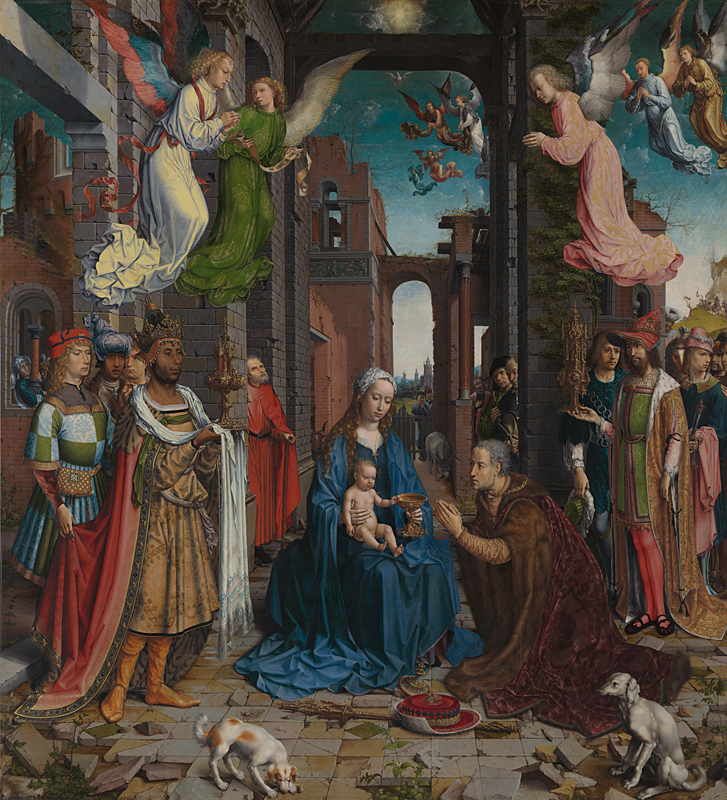
Our Lady sits in the centre with the infant Jesus on her knee. Her copious blue mantle echoes the blue sky visible through the arches of the ruined building where she sits. She and her child are the focus of this lavish and incredibly detailed painting. An elderly King Caspar kneels before them. He has presented them with a golden vessel containing gold coins. The child holds a coin in his hand. The lid, which is is on the ground at Our Lady’s feet, bears the name “Caspar”. Beside the lid are his bright red hat and his sceptre, both lying on the ground as if cast aside when he knelt in homage. A column rises in the distance directly behind him. At the top the sacrifice of Isaac is shown in relief. Just as the sacrifice of Isaac is included to foreshadow the sacrifice of Jesus on the cross, this whole crumbling ruin represents the old age, which now gives way to the new age which this child brings. If you look at this painting on the national gallery website you will be able see the detail. Behind Caspar stands the younger king, Melchior, also lavishly dressed. Melchoir holds another incredibly ornate metal receptacle. It contains frankincense. But the most elaborate vessel is the one carried by Balthazar, who stands to the left. As was customary by then, Baltazar was shown as African, not European. But Gossaert surpasses other artists in that he gets his features right. This looks like the portrait of a real African man. Of the three kings, Baltazar’s clothes are the most lavish and detailed. Around his shoulders there is a white stole. At the base it has the words from the Salve Regina woven in blue. His boots are extraordinary. They are made from some sort of very fine translucent material so that his toes are visible. Significantly, Gossaert inserted his own name on the front of this king’s headdress as if it were his signature. It also appears on the collar of Baltazar’s servant who wears an elaborate turban of lilac blue. The reason why the artist chooses to place his signature on these two figures remains unknown, but it is clear that of the three kings, Gossaert makes Baltazar the most prominent. It is thought that this painting might have been an altarpiece for a chapel at the Abbey of Geraardsbergen, which was near Brussels. The relics at the Abbey were listed in 1519 and among them was “a piece of clothing of one of the three kings”. It may be that the painting was for the chapel that housed this relic and Gossaert’s obvious skill in rendering textiles may be the reason why he was chosen. Of course, this was a time and place when textiles were both a source and sign of wealth and status. At a guess, the relic might have been that of the garment worn by Baltazar. If you look online you can see a great deal more detail not just of fabrics and ornate metal work but facial features such as stubble and a hairy wart! You will notice too that as well as the kings, there are shepherds in attendance. Two of them look on in adoration from behind the broken fence in the centre and behind them, in the distance the annunciation to the shepherds is in progress. Taken as a whole, the composition divides into an upper and lower register. The mother and child, the kings, their attendants, and the shepherds are all below while above them angels float in mid air. Also in this upper register, we see the star which guided the kings to Bethlehem and to the very place where the child was to be found. There is a subtle but definite correspondence between this world and the world above. This can be seen in the way the arrangement of the angels responds to that of the figures below. Most strikingly, Caspar’s kneeling posture is picked up by the angel above him and even by the dog beside him. Our eyes are drawn to their wings. The actual colouring of each angel’s wings is unique to that angel. We cannot hear these angels sing, but we know that their song is one of enduring and unending praise.
The Catholic Chaplaincy serves the students and staff of the University of Edinburgh, Edinburgh Napier University and Queen Margaret University.
The Catholic Chaplaincy is also a parish of the Archdiocese of St Andrews and Edinburgh (the Parish of St Albert the Great) and all Catholic students and staff are automatically members of this parish.


Follow us for news updates and inspiration. Website design by Colour Rich
St Albert's Catholic Chaplaincy is part of the English Province of the Order of Preachers, a charity registered in England and Wales (231192) and in Scotland (SC039062).