
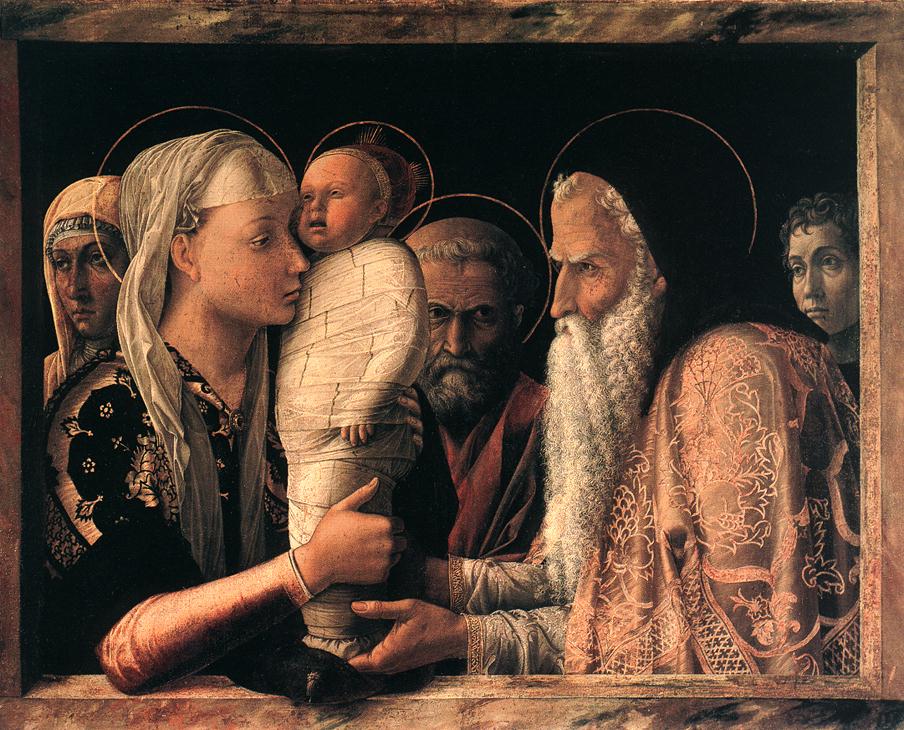
“The Presentation in the Temple”, Andrea Mantegna, c.1454, Gemäldegalerie, Staatliche, Museen su Berlin.
Mantegna captures that moment just before Mary hands over the child to Simeon. The focus of the painting is on the mother handing over her child. Mary holds the child close to her, but there is much here to suggest that other handing over which will happen when the child reaches adulthood. The child cries out as he will on the cross. His swaddling bands suggests the shroud. It was common practice for the wealthy to have within their house a private chapel or oratory, where would be celebrated. It may be that Mass was celebrated in front of this painting. Here the Christ child is held upright by his mother as a priest would hold up the host at the elevation. Mantegna sets the scene within a fictional stone frame. This frame is actually reminiscent of funerary reliefs from antiquity, which were certainly known by Mantegna and his contemporaries, so that the allusion to the cost to Mary of Christ’s sacrifice on the cross are powerfully evoked. With his Presentation the young Mantegna broke new ground among artists in the Veneto and elsewhere in Italy. In Venice and Padua, icons of Our Lady and the child Jesus were used in public churches. In such images Mary and Jesus were often shown half-length and close up. But scenes depicting a story from the gospel always showed the figures full length. Here Mantegna combines the two types of image. Apart from the frame, Mantegna does not give us a setting as such. There is no attempt to show the Temple or some detail which evokes it such as a column or an altar. We just see the figures. The half-length format ensures that the focus of the painting is on the mother and child with Simeon. Indeed, Mantegna skilfully creates the illusion that the mother and child have almost entered into the very room where the painting hangs. Her right elbow is leaning on the illusionistic frame and the cushion on which the child is stood protrudes over the edge of the frame. Simeon’s hand also breaks into our space. It is accepted that this painting dates from early on in Mantegna’s career and around the time of his marriage to Nicolosia Bellini and before he left Padua. The two figures, left and right, are thought to be Mantegna and his bride, so it would seem that the painting had some familial significance. Later on it would become a family matter in different sense. It has been shown that some 20 years later, Giovanni Bellini made another version of his in-law’s work. Actually, for his painting he traced the central figures from Mantegna’s painting. Why Bellini copied the work is not known. But while Mantegna never repeated himself in painting, by contrast, Bellini’s and his workshop regularly produced copies of, and variations on, his works. Although he copied the composition from Mantegna, Bellini’s version is different. It is less intense. Even though it has two more figures than Mantegna the figures have more empty space around them. It was Bellini’s version of the Presentation that became a “best seller” and his workshop produced many copies of it. Indeed also he used the same composition to depict the closely related circumcision of Christ.
The Catholic Chaplaincy serves the students and staff of the University of Edinburgh, Edinburgh Napier University and Queen Margaret University.
The Catholic Chaplaincy is also a parish of the Archdiocese of St Andrews and Edinburgh (the Parish of St Albert the Great) and all Catholic students and staff are automatically members of this parish.


Follow us for news updates and inspiration. Website design by Colour Rich
St Albert's Catholic Chaplaincy is part of the English Province of the Order of Preachers, a charity registered in England and Wales (231192) and in Scotland (SC039062).