
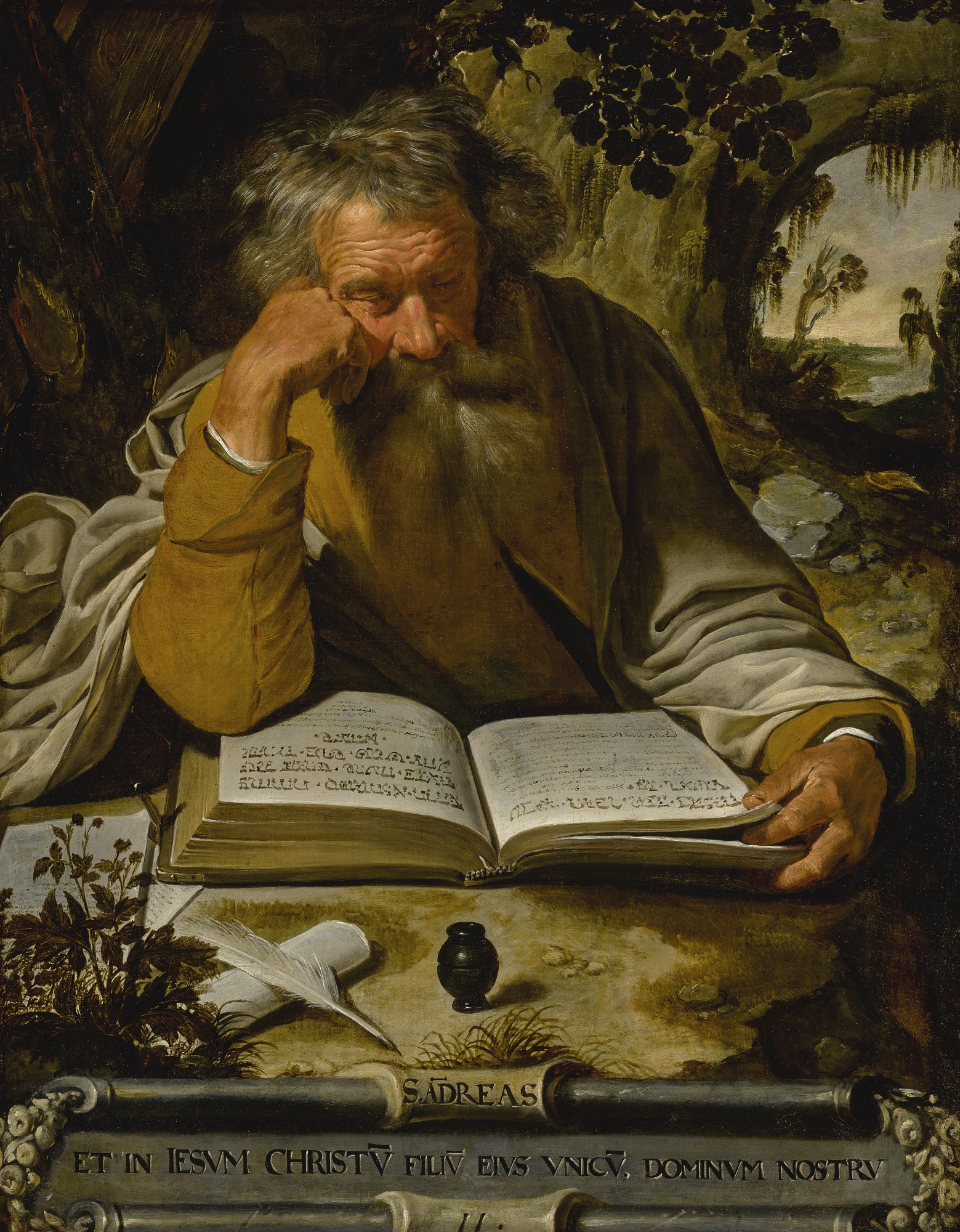
“St Andrew”, Artus Wolffort, c. 1620-25, Private Collection.
I wrote about this image before but I thought it to be appropriate for this week as we mourn the loss of Fr Fergus. We are accustomed to paintings of St Andrew either with his saltire cross or with his brother Simon Peter on the shores of the Sea of Galilee on the day when Jesus first called both of them to follow. But in this painting we are given a different view of St Andrew. Following convention, St Andrew is shown as an older man with a lot of grey hair and a substantial beard. Oddly there is a pot of ink and a quill before him, even though he is not among the authors of the New Testament. But if you look closely at the text he is reading you see that it is Hebrew. In the first chapter of St John’s Gospel, Andrew spends the day with Jesus, and then announces to his brother Simon Peter, “We have found the Messiah” (Jn 1: 41). But Andrew uses the Hebrew word “Messiah” which the evangelist translates for the reader as “Christ”. So we might surmise that this image Andrew has studied the scriptures of the Old Testament, and has come to see them fulfilled in Jesus. The inscription in Latin in front of St Andrew reads “and in Jesus Christ, his only Son, our Lord.” Actually, this article from the Apostles’ Creed is associated especially with St Andrew because of his declaration of faith in Jesus as the Messiah mentioned above. And perhaps the scroll, the ink and the quill are there simply to symbolise the handing on of the faith by the Apostles, to which St Andrew gave the whole of his life. St Andrew, Patron of Scotland, pray for us.
The Catholic Chaplaincy serves the students and staff of the University of Edinburgh, Edinburgh Napier University and Queen Margaret University.
The Catholic Chaplaincy is also a parish of the Archdiocese of St Andrews and Edinburgh (the Parish of St Albert the Great) and all Catholic students and staff are automatically members of this parish.


Follow us for news updates and inspiration. Website design by Colour Rich
St Albert's Catholic Chaplaincy is part of the English Province of the Order of Preachers, a charity registered in England and Wales (231192) and in Scotland (SC039062).