
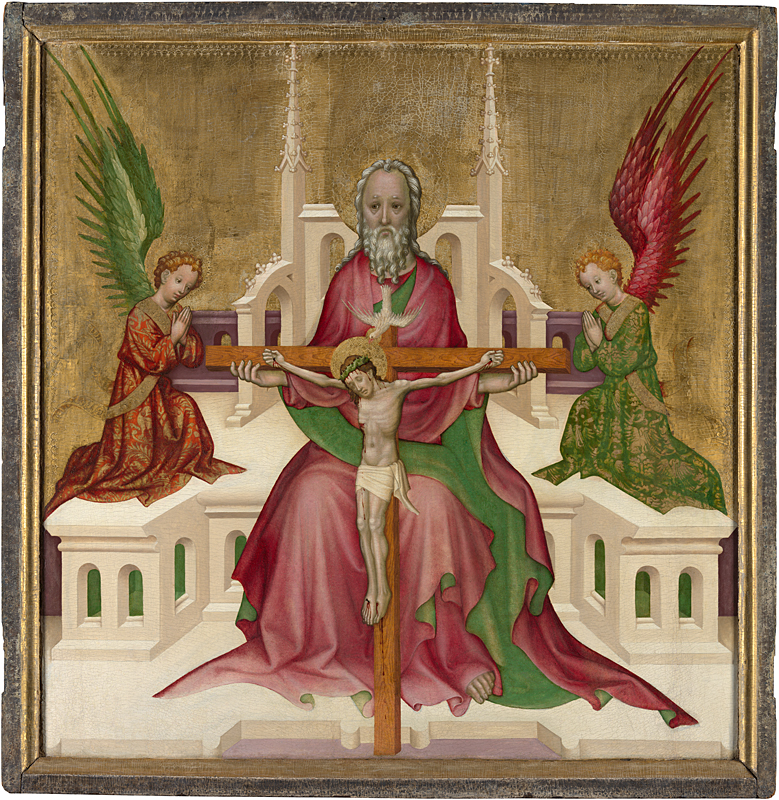
Christ’s heart is just below the centre point of this painting and the asymmetrical distribution of colour is complemented by the symmetry of the composition. Of course, no human hand can really depict the Trinity. As Jesus says in the Gospel of John: “Not that anyone has seen the Father except him who is from God” (Jn 6:46). But this kind of representation of the Trinity, where the Father is shown as the ancient of days seated on a throne and holding the Son, who is shown as Christ Crucified, with the Holy Spirit as a dove, was a common way for artists to approach the subject. It became know as the “seat of mercy”, with reference to what is written about the Ark of the Covenant, which was kept in the inner sanctuary of the Temple in Jerusalem known as the Holy of Holies. Exodus 25:10 – 22 gives instructions about the construction of the Ark. The lid of the wooden ark was to be known as the mercy seat and to have Cherubim at either end. And of this space between the cherubim the Lord says, “There I will meet with you, and from above the mercy seat, from between the two cherubim that are upon the ark of the testimony, I will speak with you of all that I will give you in commandment for the people of Israel” (Ex 25:22). In the Temple, on the Day of Atonement the priest entered the Holy of Holies, and having offered incense before the mercy seat, he sprinkled it with the the blood of a bull as an act of atonement for his sins and that of the whole people (Lev 16: 27). In the Letter to the Hebrews this annual Temple ritual is mentioned with Christ as both priest and sacrifice. “He entered once and for all into the Holy place, taking not the blood of goats and calves but his own blood, thus securing an eternal redemption” (Heb 9:12). In this image then, gold represents the Holy place of the Letter to the Hebrews, and Christ’s blood is shed on the cross. The Father wears a flowing garment of red for Christs blood and green which is the colour of hope, and life, of youth and bliss. This painting also references the dimensions of the Ark of the Covenant. The width of the mercy seat was to be two and a half cubits. The cubit was an ancient unit of length based on the length from the elbow to the palm or extended middle finger. The English word comes from the Latin cubitum meaning elbow and the associated verb cubo meaning to lie down or recline. As a unit of measure the cubit was common to many cultures. It is thought that in the Jewish usage a cubit was around 46cm, which makes two and a half cubits about 115cm, which is the width of this painting.
The Catholic Chaplaincy serves the students and staff of the University of Edinburgh, Edinburgh Napier University and Queen Margaret University.
The Catholic Chaplaincy is also a parish of the Archdiocese of St Andrews and Edinburgh (the Parish of St Albert the Great) and all Catholic students and staff are automatically members of this parish.


Follow us for news updates and inspiration. Website design by Colour Rich
St Albert's Catholic Chaplaincy is part of the English Province of the Order of Preachers, a charity registered in England and Wales (231192) and in Scotland (SC039062).