
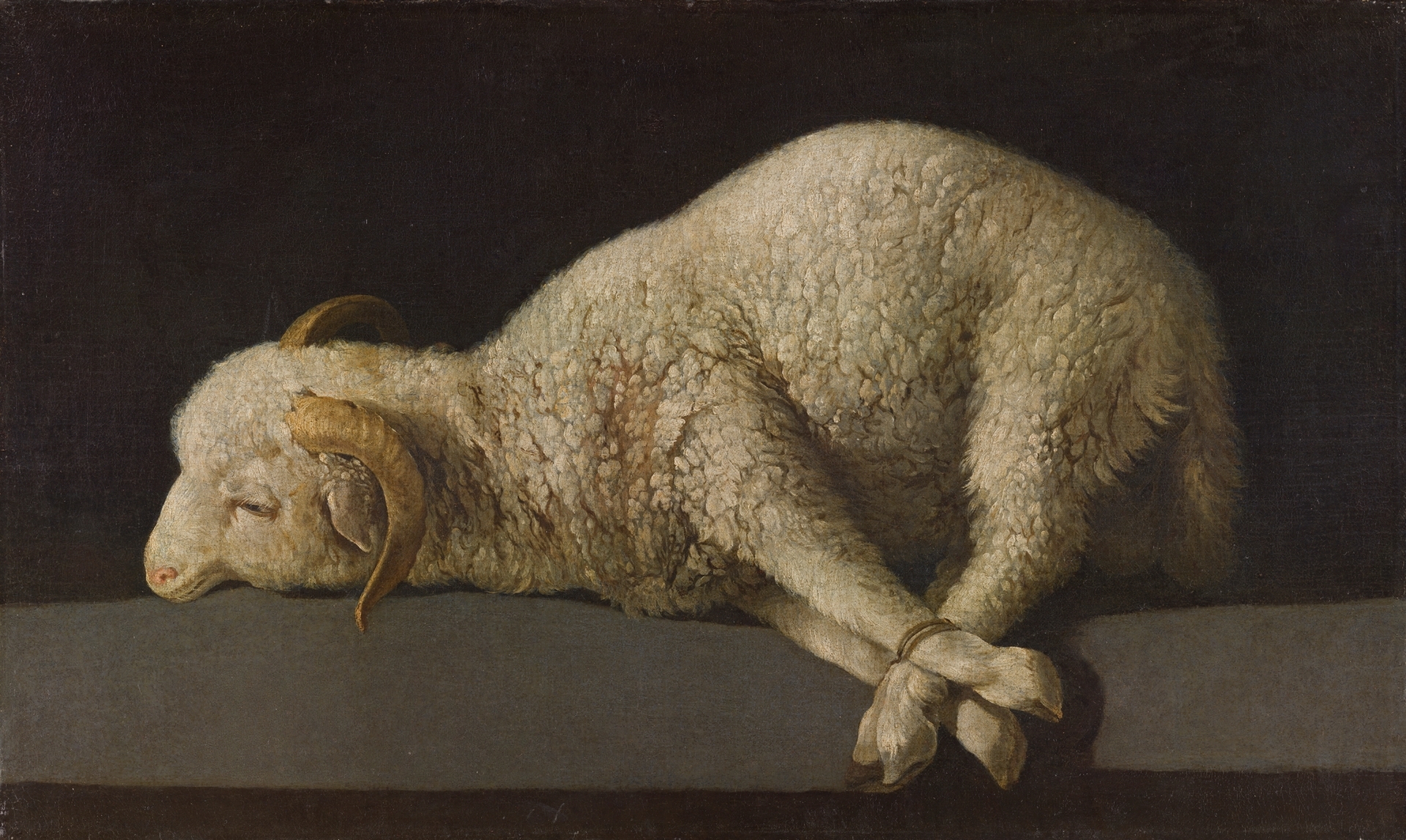
“Agnus Dei”, Francisco De Zurbarán, 1635 – 1640, Museo del Prado, Madrid.
John the Baptist saw Jesus coming towards him and declared, “Behold the Lamb of God, who takes away the sin of the world.” (Jn 1:29) This exclamation just about sums up this painting. Zurbarán painted this same subject a number of times. In some of the other versions there is a halo or the inscription “tanquam agnus” (“like a lamb”, after Isaiah 53:7-8). But this version’s impact relies solely on the artist’s skill in rendering so realistically the various textures of the lamb, especially the thick matted wool. This naturalistic rendering of detail and the use of bright light against a dark background heighten the viewer’s sense of the physical presence of the lamb. In this way, Zurbarán conveys the force of the Baptist’s word “Behold!” In the early Christian art, Christ was frequently shown as a lamb, albeit in a rather more abstract form. This symbolism draws on today’s passage from the Gospel of John and on the Book of Revelation and is intended to convey not just Christ’s sacrifice on the cross but his victory over sin and death. In fact, the sacrificial lamb is found also in many 17th Century paintings of the Nativity. Often these paintings of his birth included elements which symbolised his Passion and death. These elements ranged from more subtle hints at the Passion such as a particular bird, or piece of fruit, to the rather more direct device of a crucifix hanging on the wall of the stable or cave. By the time of Zurbarán shepherds were shown bringing a bound lamb as a gift to the Holy Child. In a painting of the “Adoration of the Shepherds”, (1638, Grenoble) by Zurbarán the shepherds have brought a bound lamb which is very similar to the lamb in this painting. Here Zurbarán there is only the bound lamb. Presumably this painting was made for a private patron who as a believer could infer the rest. To the modern viewer, this might seem an odd way of showing Christ, but for Zurbarán’s contemporaries the bound lamb was a familiar symbol of Christ as the Lamb of God. To them it conveyed his meekness, innocence, purity and the willing acceptance of his sacrifice. The gift of the lamb symbolised both devotion and the reason for it. He loved us first!
The Catholic Chaplaincy serves the students and staff of the University of Edinburgh, Edinburgh Napier University and Queen Margaret University.
The Catholic Chaplaincy is also a parish of the Archdiocese of St Andrews and Edinburgh (the Parish of St Albert the Great) and all Catholic students and staff are automatically members of this parish.


Follow us for news updates and inspiration. Website design by Colour Rich
St Albert's Catholic Chaplaincy is part of the English Province of the Order of Preachers, a charity registered in England and Wales (231192) and in Scotland (SC039062).